Mostrando postagens com marcador Grammar. Mostrar todas as postagens

quarta-feira, 19 de março de 2014

Hello guys, how are you???

Today I would like to give you an example with:

"Might" 

Might is most commonly used to express possibility
It is also often used in conditional sentences. English speakers can also use "might" to make suggestions or requests, although this is less common in American English. 

Examples:

Your book might be in the living room. possibility
If I didn't have to do my homework, I might go with you. conditional
You might visit the botanical gardens during your visit. suggestion
Might I borrow your phone? request

Practice

Match the two halves of the sentences

  1. If you do well at the test,                 _ _ _ if I get a pay rise.
  2. If you work hard,                             _ _ _ you might get the promotion.
  3. I might buy a house                         _ _ _ I might be touring Italy, too.
  4. If we arrive late                                _ _ _ we might miss the plane.
  5. If I were on holiday                          _ _ _ you might pass to the next level.
Hope you enjoyed it!!!

Take care

Elen Fernandes

quarta-feira, 6 de abril de 2011

Perguntando com HAVE/HAS!


Asking questions with have...

Bom, primeiro lembrando que quando perguntamos usando Present Perfect Tense nós usamos o auxiliar Have(I, You, We, They)/Has (He, she, it)

Ex:

Have you seen Ana this morning?
Você viu a Ana esta manhã?

Have you seen the play?
Você viu o jogo?

Have you all eaten?
Você todos ja comeram?

Have they won the game?
Eles ganharam o jogo?

Has she gone?
Ela se foi?

Hope you enjoy the tip!

Elen Fernandes

quarta-feira, 19 de janeiro de 2011

Comparando...


COMPARING (as...as / not as...as)

Hi Guys, vamos falar um pouco sobre comparativos.
Quando comparamos algo igual ou que esteja no mesmo nível geralmente usamos a extrutura as...as; ex: A Elen é tão alta quanto a Anna, nós usamos as adj as = tão/quanto - tanto/quanto.
Vamos aos exemplos porque assim fica mais claro e fácil para entender...

Ex.:

*John is as tall as his brother.
O John é tão alto quanto seu irmão. (ou seja eles tem a mesma altura)

*You should drink water as much as possible in summer.
Você deveria beber o maximo possível/tanto quanto possível de água no verão.

*You should eat as little as possible at night.
Você deveria comer o menos possivel a noite.

Deu para entender melhor agora?

E quando duas coisas são diferentes e você quer compara-las você usa not as... as

*Let’s all take a taxi. - But it’s not as cheap as going by subway or bus.
Vamos pegar um taxi. - Mas não é tão barato quanto pegar o onibus ou o metro.

That´s it for today,
I hope it´s useful...

Elen Fernandes

terça-feira, 3 de agosto de 2010

A síndrome da gramática bateu hoje. rs
Ontem tivemos uma aula de Future Perfect e achei que seria legal dividir com vocês um pouco desta extrutura.
Caso você queira praticar mais é so me mandar um e-mail, pois, tenho vários exercícios e posso ajudar com as dúvidas.

Have a great day.
Elen

The Future Perfect


Look at the sentences below:

* By the time we get to the airport, the plane will have taken off.
* By September we will have earned more than 10.000 dollars with this project.
In both sentences we used the future perfect to describe actions that will be completed at a certain time in the future.

Formation:

We form the future perfect with will have + participle.

* By November we will have already gotten our driver’s license.

The Future Perfect is used:

1. to express logical assumptions about the past, that is to talk about things which, we suppose, must have already happened.

E.g. it’s past midnight. They‘ll have gone to bed. (=I suppose they have gone to bed.)

2. for an action which will have finished before a certain future time or other future actions.

E.g. By the end of the year they will have sold both their cars.

quarta-feira, 7 de julho de 2010

Expressing quantity!


Hey folks, a pedido estou colocando uma lista de Exercicios para vocês praticarem mais o uso de Many, Much... enfim, é usando que se aprende.

Qualquer dúvida meu e-mail é english.with.elen@gmail.com.
Estarei feliz de ajudar.

I hope you enjoy it.


COUNTABLE AND UNCOUNTABLE NOUNS

A LOT

Affirmative, negative and interrogative (uncountable and plural nouns)

Ex: I’ve got a lot of books.
I haven’t got a lot of comic books.
Have you got a lot of cds?

MUCH

Interrogative and negative (uncountable nouns)

Ex: There is too much milk.
There isn’t much.
How much milk is there?

MANY

Affirmative, interrogative and negative (plural nouns).

Ex: I have many friends.
How many spoons are there?
There aren’t many.

SOME

Affirmative (uncountable and plural) It is also used in questions for offers and requests.

Ex: I want some water, please.
I have some oranges.
Would you like some sugar in your coffee?
Can I drink some water?

ANY

Interrogative and negative (uncountable and plural)

Ex: Have you got any water? No, I haven’t got any.
Has she got any potatoes? No, she hasn´t got any.

FEW

Affirmative, negative and interrogative (plural nouns).

Ex: I’ve got few books.
Have you got few apples? Yes, I’ve got few.

LITTLE

Affirmative, negative and interrogative (uncountable nouns).

Ex: I’ve got little butter.
Has she got little butter? Yes, she´s got little.

Exercises:

1- Fill the blank spaces with much or many.

1. How ______ apples did you buy?
2. How ______ do you weigh?
3. How ______ does the book cost?
4. How ______ oranges have you got?
5. How ______ times have you flown?
6. How ______ was your computer?
7. How ______ photos did you take?
8. How ______ water did he drink?
9. How ______ people did you invite?
10. How ______ mistakes did you make?
11. How ______ children are there here?
12. How ______ butter did you get?
13. How ______ furniture did you buy?
14. How ______ ice-cream do you eat?
15. How ______ water do you drink?
16. How ______ salad do you want?
17. How ______ jam does she want?
18. How ______ sandwiches shall I make?

2- A. Fill in the blanks with some or any:

1. There isn't ___ food in the refrigerator, is there?
2. I bought ____ bread and ____ cheese at the supermarket.
3. We don't have ___ sugar or flour to make the cake.
4. Don't close the door. There are still ___ children outside.
5. Why don't you decorate the room with ___ white flowers?
6. ___ people prefer to study in the morning; others at night.
7. There aren't ___ books on this topic in the library.
8. I gave him ___ medicine for his headache, so he feels much better now.
9. I have ___ dictionaries in my room that you are welcome to use.
10. Here are ___ nice ripe apples.
11. ___ matter what he does, they will not accept him in the group.
12. They haven't asked us ___ questions so far.
13. He doesn't want ___ dessert because he's on a diet.
14. He always gives ___ money to charity. He's a very generous person.
15. We are taking a short ride. There isn’t ___ time for a long one.


If you want to do the exercise and send to me I´ll be happy to correct it.

sábado, 26 de junho de 2010

Hipóteses!


Hypotetical meaning

IF ONLY – I WISH

• Used when we want to regret something we did in the past:

‘If only I had won the lottery!’
‘I wish I had won the lottery!’

• Used when we would like things in the present to be different than they are:

‘If only John wasn’t so stubborn.’
‘I wish John wasn’t so stubborn.’


SUPPOSE – WHAT IF

• SUPPOSE + PRESENT SIMPLE
To describe something that may possibly happen or may have happened.

Suppose someone sees you going into the building

• SUPPOSE + PAST SIMPLE
To talk about something that is just imagination or which is unlikely to happen in the future.

Suppose you won the lottery. What would you buy?

• SUPPOSE + PAST PERFECT
To talk about something that could have happened but didn’t in the past.

Suppose we hadn’t studied so hard. Do you still think we would have passed?
Suppose you found a lot of money, what would you do?
What if you won a lot of money, what would you do?


WOULD RATHER

• Used when we want to express a preference:

I’D RATHER + PAST SIMPLE When we want to say what we want someone or something else to do in the present or future.

I’d rather the meeting started a bit later.

I’D RATHER + PAST PERFECT When we want to say what we wanted to happen in the past.

I’d rather she had gone out more warmly dressed.

I’D RATHER + INFINITIVE (without TO) To talk about our preferences or other people’s preferences in the present or future.

They’d rather go by bus.
I would rather go to the beach than stay at home.

AS IF – AS THOUGH

• Used when we want to compare two or more situations. If the situation is real or likely, we use the Present Simple after the phrase, if not we use the Past Simple, just like with the examples above:

‘It looks as if/as though you need some rest.’ (likely)
‘He acts as if / as though he knew everything (unlikely)


IT’S TIME

• Used when we think something should have already happened long time before:

IT’S TIME + PAST SIMPLE

It’s time you went to bed, it’s already 10 o’clock.

We can also say “IT’S ABOUT TIME” or “IT’S HIGH TIME”.

It’s about time you started doing some work.
It’s high time they were here.


quarta-feira, 24 de março de 2010

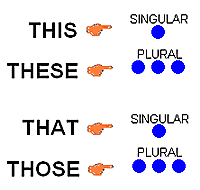
Pronomes Demonstrativos - Demonstrative Pron.


Os Demonstrative Pronouns servem para indicar e mostrar algo, algum lugar, pessoa ou objeto.
Esses pronomes podem atuar como adjetivos, antes do substantivo, ou como pronomes substantivos.

Ex:

THIS - ESTE, ESTA, ISTO (singular)

This is my car. (demonstrative pronoun)
(Este é o meu carro.) (pronome demonstrativo substantivo)

This car is red. (demonstrative adjective)
(Este carro é vermelho.) (pronome demonstrativo adjetivo)


THESE - ESTES, ESTAS (plural)

These are your books. (demonstrative pronoun)
(Estes são os teus livros.) (pronome demonstrativo substantivo)

These books are new. (demonstrative adjective)
(Estes livros são novos.) (pronome demonstrativo adjetivo)


THAT - AQUELE, AQUELA, AQUILO, ESSE, ESSA, ISSO (Sing.)

That is my house. (demonstrative pronoun)
(Aquela é a minha casa.) (pronome demonstrativo substantivo)

That house is new. (demonstrative adjective)
(Aquela casa é nova.) (pronome demonstrativo adjetivo)


THOSE - AQUELES, AQUELAS, ESSES, ESSAS (Plu)

Those are German cars. (demonstrative pronoun)
(Aqueles são carros alemães.) (pronome demonstrativo substantivo)

Those cars aren´t cheap. (demonstrative adjective)
(Aqueles carros não são baratos.) (pronome demonstrativo adjetivo)

Mais exemplos de Uso:

- Ao telefone:

Hello. This is Elen speaking. Can I talk to Patricia, please? (Alô. É a Elen quem está falando. Posso falar com a Patricia, por favor?

Is that you, Paty? (É você, Paty?)


- Apresentando pessoas:

Anna, this my sister, Barbara. (Anna, esta é a minha irmã, Barbara.)

These are my cousins, Juliana and Estela. (Estas são as minhas primas, Juliana e Estela)

Useful Phrases:

What´s that? - O que é isso?

That´s my mother - Aquela é a minha mãe.

That´s nothing - Não é nada.

That´s it - É isso é, só isso (quando termina de contar algo)

That´s great - É otimo.


I hope you enjoy the tip guys!!!

xxx
Elen

terça-feira, 5 de janeiro de 2010

Falso Cognatos / False Friends...


Bom galera, como eu havia dito este ano é pra quebrar tudo... eehehhe ;)
Ou seja, temos muita estrada pela frente para garantir o futuro do nosso
amado Inglês, e vamos que vamos rumo a fluência tão desejada e sonhada.

Hoje quero falar um pouco sobre os Falsos Cognatos, em Inglês; False Friends.
pois é, como o proprio nome diz eles são falsos... ruuhhhh...
Oh yes caro amigos, eles querem mesmo é fazer com que escorreguemos e escorreguemos buniiiitooo, mas nós não vamos deixar isso acontecer e vamos estudar direitinho esta lista de Verbos que parecem mas... não são!

Como por exemplo, a palavra pretend (todo mundo acha que é pretender, ter intenção de algo), sinto lhes informar que ña na não... Pretend significa fingir.... E quem nunca usou um falso cognato na vida atire a primeira pedra. ;)

Meu povo e minha ´pova´ eheh ;) espero estar contribuindo um poquitinho para que vocês possam aprender cada vez mais.

Vai ai a lista de falso cognatos para vocês se deliciarem com essa delícia que é o InglÊs..... eheheh ;)


Big kiss

Elen Fernandes

INGLÊS - PORTUGUÊS PORTUGUÊS - INGLÊS

Actually (adv) - na verdade ..., o fato é que ...
Atualmente - nowadays, today

Adept (n) - especialista, profundo conhecedor
Adepto - supporter

Agenda (n) - pauta do dia, pauta para discussões
Agenda - appointment book; agenda

Amass (v) - acumular, juntar
Amassar - crush

Anticipate (v) - prever; aguardar, ficar na expectativa
Antecipar - to bring forward, to move forward

Application (n) - inscrição, registro, uso
Aplicação (financeira) - investment

Appointment (n) - hora marcada, compromisso profissional
Apontamento - note

Appreciation (n) - gratidão, reconhecimento
Apreciação - judgement

Argument (n) - discussão, bate boca
Argumento - reasoning, point

Assist (v) - ajudar, dar suporte
Assistir - to attend, to watch

Assume (v) - presumir, aceitar como verdadeiro
Assumir - to take over

Attend (v) - assistir, participar de
Atender - to help; to answer; to see, to examine

Audience (n) - platéia, público
Audiência - court appearance; interview

Balcony (n) - sacada
Balcão - counter

Baton (n) - batuta (música), cacetete
Batom - lipstick

Beef (n) - carne de gado
Bife - steak

Cafeteria (n) - refeitório tipo universitário ou industrial
Cafeteria - coffee shop, snack bar

Camera (n) - máquina fotográfica
Câmara - tube (de pneu) chamber (grupo de pessoas)

Carton (n) - caixa de papelão, pacote de cigarros (200)
Cartão - card

Casualty (n) - baixa (morte em acidente ou guerra), fatalidade
Casualidade - chance, fortuity

Cigar (n) - charuto
Cigarro - cigarette

Collar (n) - gola, colarinho, coleira
Colar - necklace

College (n) - faculdade, ensino de 3º grau
Colégio (2º grau) - high school

Commodity (n) - artigo, mercadoria
Comodidade - comfort

Competition (n) - concorrência
Competição - contest

Comprehensive (adj) - abrangente, amplo, extenso
Compreensivo - understanding

Compromise (v) - entrar em acordo, fazer concessão
Compromisso - appointment; date

Contest (n) - competição, concurso
Contexto - context

Convenient (adj) - prático
Conveniente - appropriate

Costume (n) - fantasia (roupa)
Costume - custom, habit

Data (n) - dados (números, informações)
Data - date

Deception (n) - logro, fraude, o ato de enganar
Decepção - disappointment

Defendant (n) - réu, acusado
Advogado de defesa - defense attorney

Design (v, n) - projetar, criar; projeto, estilo
Designar - to appoint

Editor (n) - redator
Editor - publisher

Educated (adj) - instruído, com alto grau de escolaridade
Educado - with a good upbringing, well-mannered, polite

Emission (n) - descarga (de gases, etc.)
Emissão - issuing (of a document, etc.)

Enroll (v) - inscrever-se, alistar-se, registrar-se
Enrolar - to roll; to wind; to curl

Eventually (adv) - finalmente, conseqüentemente
Eventualmente - occasionally

Exciting (adj) - empolgante
Excitante - thrilling

Exit (n, v) - saída, sair
Êxito - success

Expert (n) - especialista, perito
Esperto - smart, clever

Exquisite (adj.) - belo, refinado
Esquisito - strange, odd

Fabric (n) - tecido
Fábrica - plant, factory

Genial (adj) - afável, aprazível
Genial - brilliant

Graduate program (n) - Curso de pós-graduação
Curso de graduação - undergraduate program

Gratuity (n) - gratificação, gorjeta
Gratuidade - the quality of being free of charge

Grip (v) - agarrar firme
Gripe - cold, flu, influenza

Hazard (n,v) - risco, arriscar
Azar - bad luck

Idiom (n) - expressão idiomática, linguajar
Idioma - language

Income tax return (n) - declaração de imposto de renda
Devolução de imposto de renda - income tax refund

Ingenuity (n) - engenhosidade
Ingenuidade - naiveté / naivety

Injury (n) - ferimento
Injúria - insult

Inscription (n) - gravação em relevo (sobre pedra, metal, etc.)
Inscrição - registration, application

Intend (v) - pretender, ter intenção
Entender - understand

Intoxication (n) - embriaguez, efeito de drogas
Intoxicação - poisoning

Jar (n) - pote
Jarra - pitcher

Journal (n) - periódico, revista especializada
Jornal - newspaper

Lamp (n) - luminária
Lâmpada - light bulb

Large (adj) - grande, espaçoso
Largo - wide

Lecture (n) - palestra, aula
Leitura - reading

Legend (n) - lenda
Legenda - subtitle

Library (n) - biblioteca
Livraria - book shop

Location (n) - localização
Locação - rental

Lunch (n) - almoço
Lanche - snack

Magazine (n) - revista
Magazine - department store

Mayor (n) - prefeito
Maior - bigger

Medicine (n) - remédio, medicina
Medicina - medicine

Moisture (n) - umidade
Mistura - mix, mixture, blend

Motel (n) - hotel de beira de estrada
Motel - love motel, hot-pillow joint

Notice (v) - notar, aperceber-se; aviso, comunicação
Notícia - news

Novel (n) - romance
Novela - soap opera

Office (n) - escritório
Oficial - official

Parents (n) - pais
Parentes - relatives

Particular (adj) - específico, exato
Particular - personal, private

Pasta (n) - massa (alimento)
Pasta - paste; folder; briefcase

Policy (n) - política (diretrizes)
Polícia - police

Port (n) - porto
Porta - door

Prejudice (n) - preconceito
Prejuízo - damage, loss

Prescribe (v) - receitar
Prescrever - expire

Preservative (n) - conservante
Preservativo - condom

Pretend (v) - fingir
Pretender - to intend, to plan

Private (adj) - particular
Privado - private

Procure (v) - conseguir, adquirir
Procurar - to look for

Propaganda (n) - divulgação de idéias/fatos c/ intuito de manipular
Propaganda - advertisement, commercial

Pull (v) - puxar
Pular - to jump

Push (v) - empurrar
Puxar - to pull

Range (v) - variar, cobrir
Ranger - to creak, to grind

Realize (v) - notar, perceber, dar-se conta, conceber uma idéia
Realizar - to carry out, make come true, to accomplish

Recipient (n) - recebedor, agraciado
Recipiente - container

Record (v, n) - gravar, disco, gravação, registro
Recordar - to remember, to recall

Refrigerant (n) - substância refrigerante usada em aparelhos
Refrigerante - soft drink, soda, pop, coke

Requirement (n) - requisito
Requerimento - request, petition

Resume (v) - retomar, reiniciar
Resumir - summarize

Résumé (n) - curriculum vitae, currículo
Resumo - summary

Retired (adj) - aposentado
Retirado - removed, secluded

Senior (n) - idoso
Senhor - gentleman, sir

Service (n) - atendimento
Serviço - job

Stranger (n) - desconhecido
Estrangeiro - foreigner

Stupid (adj) - burro
Estúpido - impolite, rude (Rio Grande do Sul)

Support (v) - apoiar
Suportar (tolerar) - tolerate, can stand

Tax (n) - imposto
Taxa - rate; fee

Trainer (n) - preparador físico
Treinador - coach

Turn (n, v) - vez, volta, curva; virar, girar
Turno - shift; round

Vegetables (n) - verduras, legumes Atualmente - nowadays, today
Vegetais - plants

quinta-feira, 17 de dezembro de 2009

WHOSE or WHO'S


Hi folks...

Do you know the difference of WHOSE and WHO´S????


Whose is possessive. It shows ownership.

Examples:
Whose book is this? It’s Peter’s book.

Mrs. Brown, whose husband died last week, was born in New York.

Who’s is a contraction for who is or who has.

Examples:

Who’s your brother? = Who is...
Who’s at home? = Who is...
Who’s been waiting for a long time? = Who has...
Who’s got many books? = Who has...

I hope it´s helpful guys.

xxx
Elen

segunda-feira, 30 de novembro de 2009

Past Perfect


PAST PERFECT

O Past Perfect é o passado do Present Perfect.
Este tempo verbal descreve uma ação passada anterior a outra também no passado.

Estrutura:
O Past Perfect é um tempo composto por dois verbos: um auxiliar e outro principal.
O auxiliar é o verbo had(passado simples de to have) e o verbo principal é aquele conjugado no particípio passado.

Modelo de extrutura:
Sujeito + Verbo to have conjugado no passado (had) + Verbo principal no particípio passado + Complemento

Ex:

She had spoken to him when I entered the room.
(Ela tinha falado com ele quando eu entrei no quarto.)

Paul didn’t want to come to the movies with us because he had already seen the film twice.
(Paul não quis ir ao cinema conosco, pois ele já havia visto o filme duas vezes.)

When I arrived at the party, Anna wasn’t there. She had gone home.
(Quando eu cheguei na festa, Anna não estava lá. Ela havia ido para casa.)


Galera vou colocar um link de um site para praticar Past perfect. Enjoy it!
www.britishcouncil.org.br/etp/unit18a.html

quinta-feira, 26 de novembro de 2009

Present Perfect - Gramatica


So many people are asking me to post more grammar points. So there you go....
I hope it helps you to understand Present Perfect.

Galerinha do meu coração, tem muita gente pedindo gramatica por aqui, então para alegra-los, la vão algumas dicas.
Espero que ajude!!!

Big kisses

Elen

Present Perfect

Uso:

Expressar uma ação que aconteceu num passado recente, porém não determinado:

Ex.: I have painted the house.

Também pode expressar a ação que acabou de acontecer.

Ex.: I have just painted the house.

Outros advérbios comumente empregados com o Present Perfect neste uso são:


yet (já), em perguntas: Has she washed the car yet?
already (já), em frases afirmativas: He has already painted the house.
ever (já, alguma vez), em perguntas: Has he ever visited Paris?
never (nunca), em frases com sentido negativo: He has never visited Disney World.

Forma:

Sujeito + verbo to have + verbo principal (partícipio passado do verbo principal).

Ex.: I/You/We/They have painted.
He/She/It has painted.

Negativa

Ex.: I/You/We/They have not (haven't) painted.
He/She/It has not (hasn't) painted.

Interrogativa

Have I/You/We/They painted?
Has He/She/It painted?

Conceito:

O Present Perfect é um tempo verbal que não tem um equivalente em português. Normalmente, indica ações que ocorreram no passado e perduram até o presente, ações de um passado indeterminado e ações recentemente concluídas.

Eu morei em Londres por 6 anos.

Nós estudamos Inglês desde os 7 anos.

Você tem feito coisas recentemente.

Estrutura:

O Present Perfect é um tempo composto por dois verbos:
--> um auxiliar e outro principal.
O auxiliar é o verbo to have (no presente simples), ou seja: have (para: I, you, we, they) ou has (para: he, she, it). O verbo principal sempre deve estar no particípio.

A estrutura das sentenças:

Sujeito + Verbo auxiliar have conjugado no presente + Verbo principal no particípio+ Complemento

quarta-feira, 18 de novembro de 2009

PASSIVE VOICE - VOZ PASSIVA

Alguns alunos andam me combrando pra colocar mais gramática no blog, pois, então... vocÊ mandam...

Let´s get started!!!

PASSIVE VOICE - VOZ PASSIVA

É quando o objeto de uma oração direta passa a ser sujeito de uma oração indireta.

Ok! Não ajudou muito né!!!...
Vamos la então:

Regra: Para passar uma oração para a voz passiva, coloca-se o verbo to be no mesmo tempo verbal do verbo principal da oração na ativa, que é necessariamente passado para o particípio.

Afff Jesus.... o que é isso???
Calma galera... ja estamos chegando la...

Voz passiva é:

Simple Present: am / is / are (not)

Simple Past: was / were (not)

Future: will be

Present Continuous: is / are being + PARTICIPLE

Past Continuous: was / were being ex: done, taken, gone,etc.

Conditional: would / may be

Present Perfect: has / have been

Past Perfect: had been


Exemplos de transformações de transformações:

Voz ativa:


writes (simple present)

wrote(simple past)

was / were writing (past continous)

have / has written (present perfect)

had written (past perfect)

would write (conditional)

will write (future)


Voz passiva

is / are written

was / were written

was / were being written

has / have been written

had been written

would be written

will be written

Exemplos (primeiramente na voz ativa, seguido de voz passiva):

•They will write that book. (Eles escreverão aquele livro).

That book will be written by them. (Aquele livro será escrita por eles).


Note que ambas as orações são compostas da seguinte forma:

Sujeito+Verbo+Objeto, e o que é objeto em uma é sujeito na outra.

• Somebody cleans the house every day. (Alguém limpa a casa todo dia).

The house is cleaned every day. (A casa é limpa todo dia).

Note a mudança do verbo: na oração na voz ativa o verbo se encontra apenas no Simple Present, já na voz passiva existe uma locução verbal entre o verbo to be no presente e o verbo principal clean no particípio cleaned.

•Somebody cleaned the house yesterday. (Alguém limpou a casa ontem).

The house was cleaned yesterday. (A casa foi limpa ontem).

O mesmo exemplo, porém no passado.

•People have watched the World Cup. (As pessoas assistiram à Copa do Mundo).

The World Cup have been watched. (A Copa do Mundo foi assistida – veja que, no português padrão, não existe a forma passiva dessa oração, já que o verbo assistir, nesse contexto, é transitivo indireto).

Note, que neste caso não há necessidade de inserir “by people” (pelas pessoas) na voz passiva.

•Picasso painted “Guernica”. (Picasso pintou “Guernica”).

“Guernica” was painted by Picasso. (“Guernica” foi pintada por Picasso).


•South Africa produces about half of the world’s gold. (A África do Sul produz cerca de metade do ouro do mundo).

About half of the world’s gold is produced by South Africa. (Cerca de metade do ouro do mundo é produzida pela África do Sul).


•Anyone can plant a tree. (Qualquer um pode plantar uma árvore).

A tree can be planted by anyone. (Uma árvore pode ser plantada por qualquer um).


•Shakespeare wrote “Romeo and Juliet”. (Shakespeare escreveu “Romeu e Julieta”).

“Romeo and Juliet” was written by Shakespeare. (“Romeu e Julieta” foi escrito por Shakespeare).


•Somebody is painting the door. (Alguém está pintando a porta).

The door is being painted. (A porta está sendo pintada).


I hope it can help guys.

Big kiss

ELen Fernandes

quinta-feira, 6 de novembro de 2008

Present Simple

(+) S + Infinitive *(-s)
(-) S + don’t / doesn’t + Infinitive
(?) Do / Does + S + Infinitive?

Uses:

 Habits and Routines
Jane always studies in the library

 To talk about true facts
Water boils at 100¨C

 Permanent situations
They don’t live in London any more.

 With State Verbs*
I don’t understand the text

 To form the 0 and 1st Conditionals
If she doesn’t come, we won’t go out.

 Timetables (SEE FUTURE)

Common words:

FREQUENCY ADVERBS: always, usually, normally, often, sometimes, occasionally, rarely, seldom, hardly ever, never

TIME EXPRESSIONS: nowadays, every day, once a week, from time to time, in summer, on Mondays, etc

Past Tense

Past Simple

(+) S + Verb Past
(-) S + didn’t + Infinitive
(?) Did + S + Infinitive?

Uses:

 Finished actions in the past.
Last week, I didn’t go to the cinema with my sister.

 To talk about something that happened regularly in the past
When I was a teenager I went to English classes twice a week.

 A series of actions in the past.
He entered a room, lit a cigarette and smiled at everyone.

 To form the 2nd Conditional
If I were you, I wouldn’t buy that car

Common words:

Yesterday, the other day, last…, ago, in (year), when…

segunda-feira, 13 de outubro de 2008


Pronomes

Definição: São os pronomes e adjetivos que indicam posse (meu, seu, teu, dele, etc).

Pes. - Adjetivos Possessivos - Pronomes Possessivos

I - My - Mine (meu)

You - Your - Yours (seu)

He - His - His (dele)

She - Her - Hers (dela)

It - Its - Its (disto)

We - Our - Ours (nosso)

You - Your - Yours (seu(s))

They - Their - Theirs (deles,delas)


Exemplos:

I have a car.
Eu tenho um carro.

That’s my car.
Aquele é o meu carro.

That car is mine.
Aquele carro é o meu

He is telling his story because he knows it will destroy him.
Ele esta contando sua história por que sabe que ela vai destruí-lo.

He is telling a story, that is his, because he knows it will destroy him.
Ele esta contando uma história, que é a sua, por que sabe que ela vai destruí-lo.

We have a mission: providing policy-independent data.
Nós temos uma missão: prover dados independentes de política.

Our mission is to provide policy-independent data
Nossa missão é prover dados independentes de política.

The mission of providing policy-independent data is ours.
A missão de prover informações independentes de política é nossa.

Pronomes interrogativos

Como o própio nome já sugere,Os pronomes interrogativos se incerem num contexto entre sujeito e objeto. São eles: what who which whom where how Who e whom. A duvida constante entre muitos estudante de lingua ingles, é escolher qual e quando usa-los.
Se a minha intenção é concordar com o sujeito neste caso usarei o who, que traduzindo ficará quem, que ou o qual.
ex: this is the man who Mary loves (Este é o homem que Mary ama). Note que o pronome concordou com o sujeito.
Notemos agora outro exemplo agora utilizando o whom that is the man whom smell let Mary out of control (Aquele é o homem cujo o cheiro deixa Mary louquinha).

Pronomes reflexivos

I-Myself
You-Yourself
He-Himself
She-Herself
We-Ourselvels
You-Yourselves
They-Themselves